
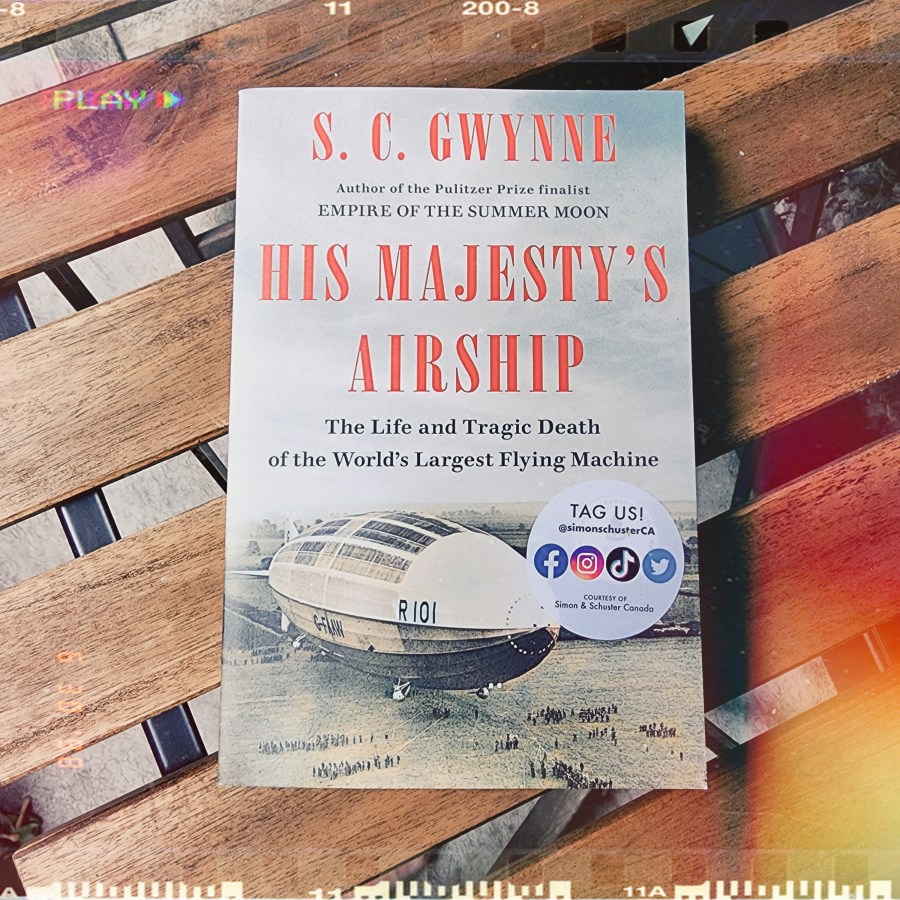

His Majesty’s Airship is the latest non-fic from Pulitzer prize finalist SC Gwynne, author of Empire of the Summer Moon. The books tells the story of the British Airship R101, which went down a huge blazing crash in 1930, causing more deaths than the Hindenburg disaster 7 years later. At the time, airships had been used in WW1 and were the hope of bringing far flung countries in the British Empire into reach, but in reality were dangerous gas filled balloons prone to accident and failure. This book is the story of the ambitious lord who dreamed them up, the Romanian princess who was his paramour and a pilot who was a national hero slowly devolving into alcoholism.
His Majesty’s Airship is a smooth moving story and takes a friendly, conversational tone, which is needed here because there’s a lot of details and different people involved that could bog down the story if not handled well. It covers the history of these flying machines, how they work, the lives of the people involved, and, of course, the through line is the story of the R101’s flight that led to it’s exploding in a fireball and tragically causing the deaths of most of it’s passengers and crew.
What is it about these zeppelins and airships that’s so insanely appealing? To me, they’re a little bit steampunk, like deadly diabolical weather machines from old adventure stories or like something magical from a Studio Ghibli film. They had smoking lounges, sleeping quarters and bars on them, and people would pack luggage and dress for dinner. And there are these amazing characters surrounding their creation, counts and heads of state, dashing airmen ready to risk it all to fight for victory. The real story of these airships, as I learned in this book, is kind of bonkers, so my sense of them was not completely wrong. They were incredibly dangerous, full of highly flammable gas that could be sparked by something as simple as static electricity and made from materials that were fragile and could be damaged by the slightest scratch. They were huge and unwieldly, unsafe to fly in most weather conditions but had caught the imagination and the egotism of some powerful people and in their rush to get them flying passengers, safety checks were not really done. R101 was more of a prototype than anything, something minimally tested and still in the experimental stage, but no one in charge was willing to accept this. Things could go so wrong on these airships so easily, they frequently did, and when they did, they ended in a huge ball of flame. And often no one survived.
Suffice it to say, I really enjoyed this book. I only had an impression of these flying machines before reading this, and I was really interested in how they worked and what their history was. I was also intrigued by the people the book describes, there are the three mentioned above, but also a lot of other people involved in these airships and their creation. It was such a different time in history and people’s lives and attitudes, the times, were so different.
There’s a bit towards the end where I got a little bogged down in technical details, but generally, this book is nicely paced, has loads of detail that it gets across well because of it’s easy going style. It takes a very interesting chapter of history and brings it to life. I learned a lot.
Read It If: history buffs and those who love the turn-of-the-century era will enjoy this one. Excellent non-fiction.
Thank you to Simon and Schuster for the ARC of this book for review.
 CravenWild