
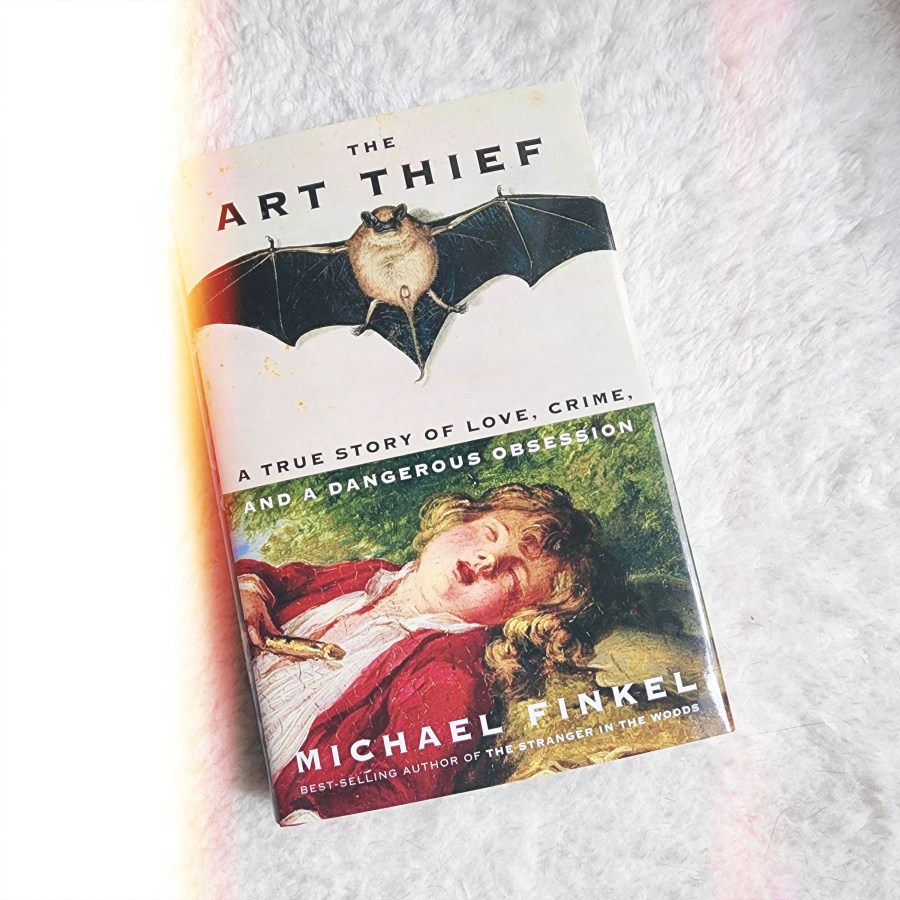
Stephane Breitwieser is the most prolific art thief of all time, taking art works and historical objects from museums all over Europe with the help of his girlfriend in broad daylight, amassing a collection worth over $2 billion. All of which he kept for his own enjoyment in his attic bedroom in his mother’s house. He never sold a piece. This is the story of who he was, what he did, and how it all came crashing down.
Michael Finkel is a journalist and the author of the acclaimed The Stranger In The Woods. The book is detailed and well researched, with descriptions about the items stolen and the order of events, interspersed with background information that brings us into the odd world of the people involved. It’s a structure that’s used well, but can be slightly repetitive in some places.
At the start of the book, we’re offered the quote from Oscar Wilde, “Aesthetics are higher than ethics.” I liked this because while the book is partly a study of an interesting crime, it’s also one that wants to explore the character of the main player and there’s something elusive about Stephane and his mother and girlfriend. What drove him to be the way he was? There is not one definitive opinion on this, but I found it really interesting that while it was suggested that Stephane was perhaps a narcissist or kleptomaniac, he may have been suffering from Stendahl Syndrome, which I hadn’t heard of before and refers to an intense reaction to art, bordering on a spiritual experience that some people have. (People with that syndrome don’t generally steal art, but it suggests something about the compulsion and the intense needs and feelings of the thief).
The book isn’t especially long, but it has plenty of detail and it’s a fascinating story and character study. Imagine living in that attic surrounded by that kind of opulence, and what that might feel like and how it might change how you think about yourself and your place in the world. There’s also a sense of mystery around the whole, something unsolved, because in the end, we sense that there’s a lot to the girlfriend and mother and their relationship with Stephane that we will just never know. There’s also something about Stephane himself that’s strange and elusive, and not all of the art works were found. (I won’t tell you why, because spoilers, but there’s something that happens at the end with the art works that was almost physically painful to read about!)
A fascinating true crime story that’s less violent but just as compelling as the more bloody tomes in this canon.
Read It If: You love non-fiction about heists and crime, strange and interesting people, and odd Bonnie and Clyde relationships, this one is a must read.
Thank you to Penguin Canada for the copy of this book for review.
 CravenWild