
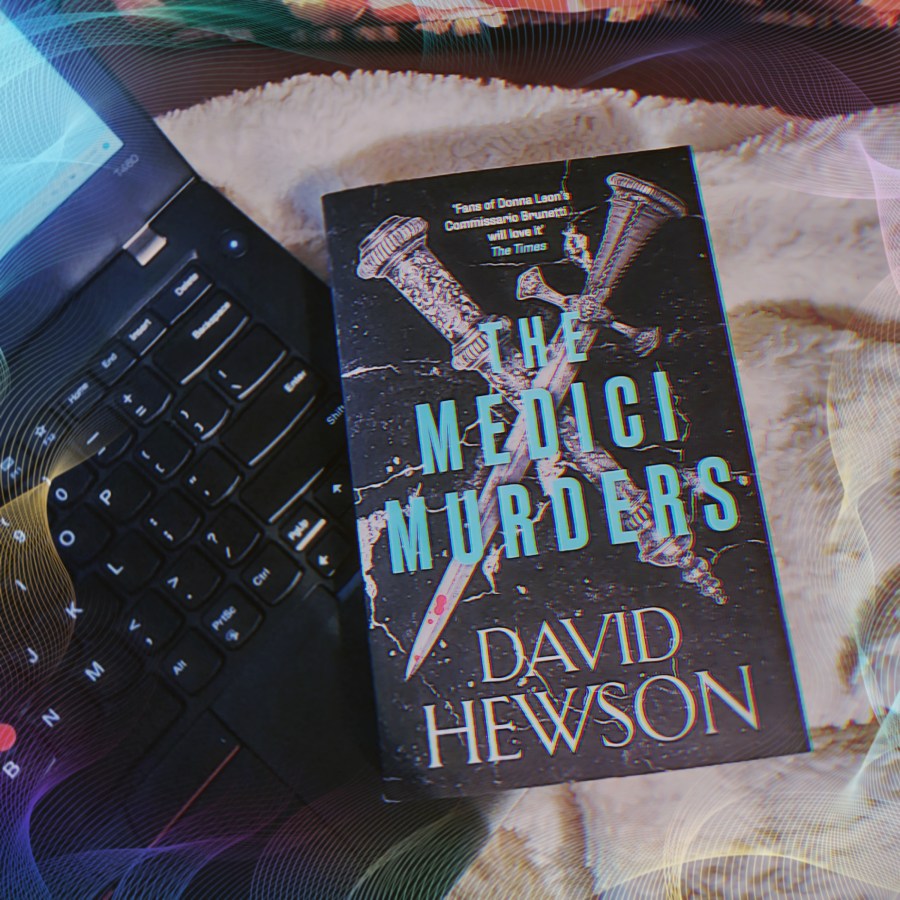

Arnold Clover is an archivist, living in Venice following the recent death of his wife, when he’s asked to assist the Carabinieri in the case of the murder of British TV historian Marmaduke Godolphin, who was killed in the same manner as Lorenzo de Medici in 1548. Not only had Clover recently been hired by Godolphin to work on a discovery that would have revived the man’s career, but he also went to the same university and knows all the players in the deceased man’s milieu. As he goes back to the beginning to tell his story, we discover that Godolphin had a lot of enemies and a lot of secrets, and any of of the people around him may have had reason to kill him.
According to Goodreads, this is the first in a planned series about Arnold Clover, our archivist and Yorkshire man. And we are in good hands. David Hewson is the author of the Nic Costa series, set in Rome, and the Pieter Vos, set in Amsterdam, both mystery series with nice settings and interesting leading characters. To me, in style, this is very much commercial fiction, which works really well for this kind of story. He clearly loves Venice and writes about the food, the locals and the streets there in a way that felt very real and rang true. His characters are slightly stock characters, but in a way that means they are recognisable, and not cookie cutter, and he writes in a very to-the-point way. It’s what you would expect from a man who started out in journalism and I like it. It’s genre fiction and it hits the spot. I feel transported to a beautiful city and into the story, but the book never lags.
The structure of the book is that Clover is brought into the police station and told he has 24 hours to tell the story of what each character said to him, putting some tension in place by having a time limit and spooling the story back as he tells it. (It reminds me a bit of a structure that Agatha Christie used once, in The Murder Of Roger Ackroyd, but that may be giving away too much) Conveniently, he had taken it upon himself to extend a personal invitation to each of the characters to show them something of Venice that they might like, separately, therefore he had spent a little time with each one. This is the kind of thing that might be a bit unrealistic or too easy, but this works because of that tone. The book invites us to relax and enjoy a genre mystery, in an old style. Not hyper real or gritty, but still believable and entertaining.
Personally, I loved that our lead was an archivist and the book has a slightly Gothic or Dark Academia like atmosphere. There’s winding alleys, historical figures, gondolas, masked players, old libraries, boxes of documents, stuffy colleges and jeweled knives. I love all the archive and library talk in this book. It’s necessary exposition, but talk dusty shelves to me. You have my full attention. I also think it’s a nice detail that our lead character is squeamish. In a time of popular true crime and gory murder stories, this book gives us a man who is not desensitized to violence, and I liked that. He’s an analog man in a digital world, but he’s sympathetic. Human.
There are a couple of missteps here. The Italian Capitano Valentina is overly beautiful and mixes her English metaphors. It feels a bit cartoonish, but not awful. Some of the dialogue is a but awkward. It’s a bit unlikely that he would be drawn into the case the way he is. In the end, it feels contrived, once you see the mystery solved. I feel like that’s not an issue because that’s the kind of book it is, it’s fast, fun, entertaining genre fiction. I would read more of this series.
Something I am noticing is that recent books seem to have a page in the second chapter that feels like a statement, and I can almost predict what page it will be on. It’s the part where our main character let’s us know he respects women, we are given a token LGBT/minority character, introduced to a white male boomer who will be the bad guy, and a female character will say something long suffering. And then the story will resume. Don’t get me wrong, I don’t have an issue with the politics here, but the way it’s like a box that needs to be ticked, a statement made. It’s awkwardly forced and could much more easily be written into the story as a whole.
On the whole, I liked this one and if there are more in the series, I look forward to reading them. I liked the world of the story and the main character, and I sometimes really love a book that’s a straight, old fashioned style mystery like this.
Read It If: you like mysteries set in beautiful European cities. This has a neat plot, some bookish vibes, and a great lead character.
Thank you to PGC Books for the copy of this book for review.
 CravenWild