

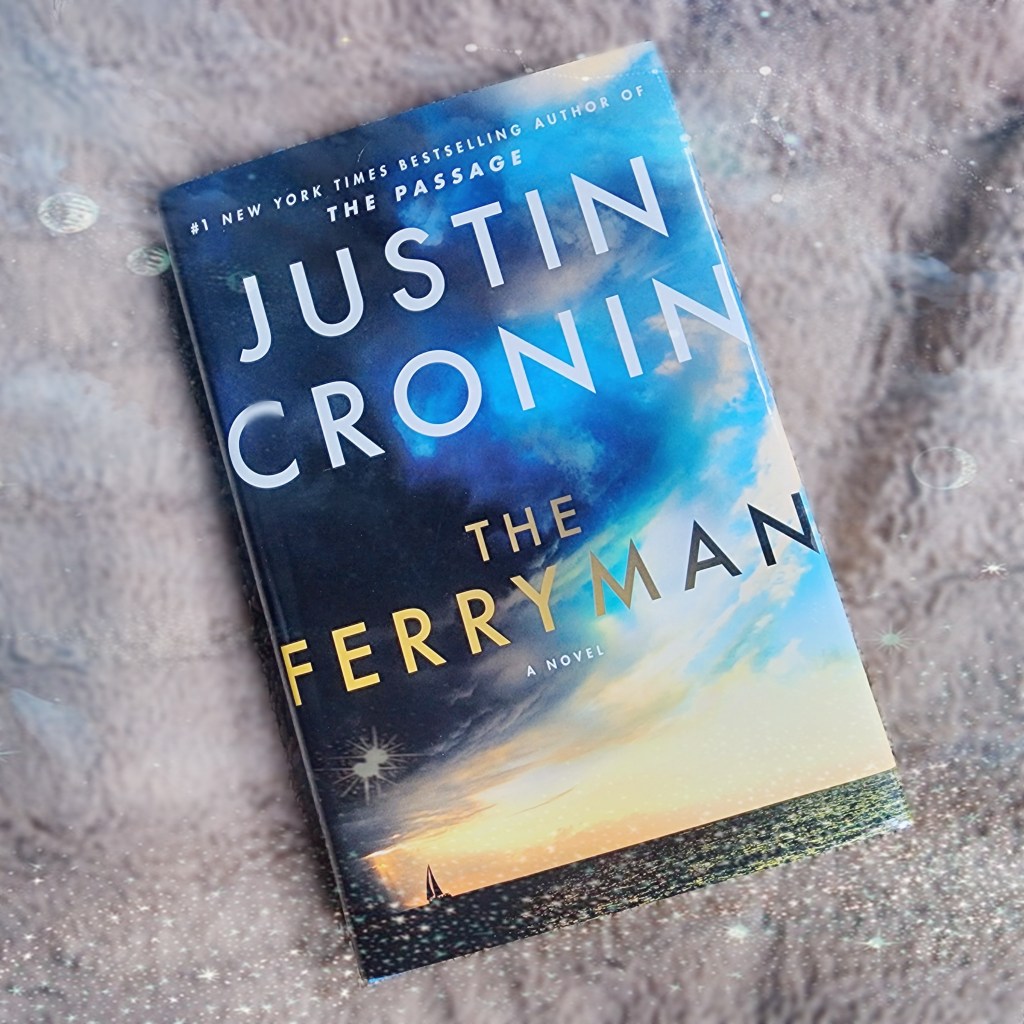
On Prospera, a futuristic island, Proctor is a Ferryman, a man whose job it is to take inhabitants at the end of their 120 year lifespan, to the ferry which takes then to another island for reiteration. It’s a mystery what that is exactly. Today, Proctor has been called to the home of his adoptive father, whose life is at its end, though they haven’t spoken much in 12 years since his mother’s suicide. As his father gets to the ferry, he gives Proctor a strange message, which makes Proctor start to ask dangerous questions, questioning the very nature of the island and that the servant underclass are happy with their lot, crammed into The Annex, a second, lesser island.
Justin Cronin is the author of The Passage series, which is a very popular series and one that, like this one, is rather chunky and is trying to explore some interesting ideas. The Ferryman is a standalone, science fiction novel, but has the authors trademark length and exploration of cerebral plots and ideas.
I’m quite drawn to the mysterious, futuristic island, uncover the truth story, like Logan’s Run from 1976 or The Island from 2005. I suppose it’s like exploring a dystopian future, but with a closed world and less gritty idealisation, and better lighting. These worlds are often made to look appealing, and the rotten state of things is hidden underneath. The fun starts in the world building, and ends in us solving the mystery that is always at the heart of these stories, what’s really going on.
Initially, I liked the world of this story and it’s rules, it’s a peaceful and innocent space, but has a sterile feel, a bit strict and emotionless. It’s a world that works and makes sense. I felt like Proctor was a really interesting person in that context, and was interested in what would happen to him, as both of his parents at their deaths had broken the shell and shown strong emotion. Would he do the same? What was happening under the surface here? The issue was that the book was just too long at some 500 pages, and not much was happening at all. I kept losing interest with dull scenes of description that didn’t further the plot at all, and didn’t take us deeper into the characters either. It became dull. I wanted to care more about the b plot involving The Annex and that story, but I was so bored, I just couldn’t care enough. At the last section of the book, the whole world of the story is upended, and everything you thought you knew changes. This was fine, but took way too long to get there and I think is trying to be a bit more clever than it really is, as an idea.
It’s OK, on the whole. The author writes in a way that’s easy to read, but this one was just too long and, for me, trying too hard to be different and clever. It felt a bit overwritten and underdeveloped, and the ending is not as unpredictable as the author might think and it felt a bit weak.
Read It If: this one should please fans of the author and those of you who like long, slow burn science fiction. For me, it was just an OK read.
Thank you to the publisher for the copy of this book for review.
 CravenWild