
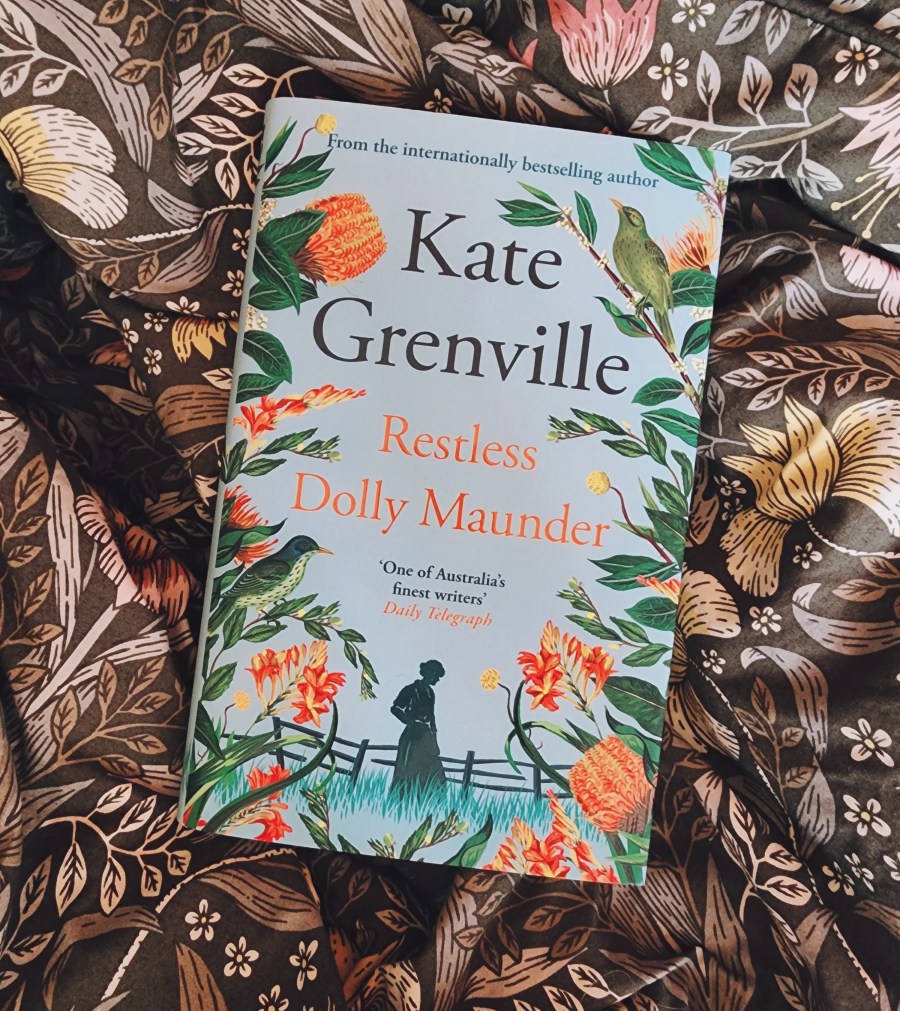
In NSW, Australia in 1881, young Dolly compares her downtrodden, hard working mother to the local school teacher, who is able to walk with her head high and has more independence. She feels determined to find a way out of the narrow life prescribed to women. When she is finally prevailed upon to marry, her marriage has bitter times, but she becomes the captain of her own ship by making savvy financial decisions for her family, moving them around from place to place to increase their income.
Kate Grenville is a beloved Australian author who has written several books. I’ve previously reviewed her book A Room Made Of Leaves HERE. That one was also about an interesting, strong woman from Australia’s history. This book is based on the author’s own family history. Dolly is Grenville’s own grandmother, who she has some memories of. She has combined research and her knowledge of the times she’s writing about with family anecdotes and stories to create a very interesting story about a tough and fascinating woman.
The book carries us through Dolly’s life from childhood til death, through childhood to marriage, the turn of the century, war, three children, retirement, back into the workplace, the Roaring Twenties, the Great Depression and on into old age. Each chapter shifts us a few years forward. It’s not a long book, and I liked how the structure worked for the story and passage of time. There are no quotations around the dialogue, which is a style choice that I don’t really love, but it’s also not a major problem.
What’s really compelling about this book is the family dynamics and the place in the world that Dolly makes for herself. She’s born into a very hard place and time. Women had no agency, limited education, and were really defined by who they were the daughter or wife of, having no status of their own. They were also times when children were seen and not heard. Her own mother is bowed by grief and hard work, and is a bit distant. Her father is rough and cold, uneducated. There was no time for feelings or indulgence. This really shapes Dolly’s life. She becomes the leader and the entrepreneur in her family after she’s married, she has an excellent head for business, but as a mother, she isn’t able to express her love and feelings for her children freely. She longs to be able to get out of her own way and soften sometimes. But she’s never had that modelled for her, and it feels like such an everyday tragedy. At the end of the book, Grenville tells how her mother, who was Dolly’s daughter, wondered why Dolly could never love her. It’s so sad. Grenville really thinks into this and the way that the hard times and the emotional reticence of the era really shaped Dolly. She finds her heart and I think that’s such a wonderful thing about this novel.
Outside if this, the book is a slice of Australian women’s lives and history, and points out that that generation of women was like a hinge for change in women’s freedom and status. It’s a page turning story about a woman who had a cool head for business and led an interesting life, at a time when there was a lot historical events and change, and the roles that women could take started to open up. I liked this book and it made me think about all the more ordinary lives that don’t make the history books. A great read.
Read It If: a portrait of a fascinating woman and a journey through time, a great, heartfelt read.
Thank you to PGC Books for the copy of this book for review.
 CravenWild