

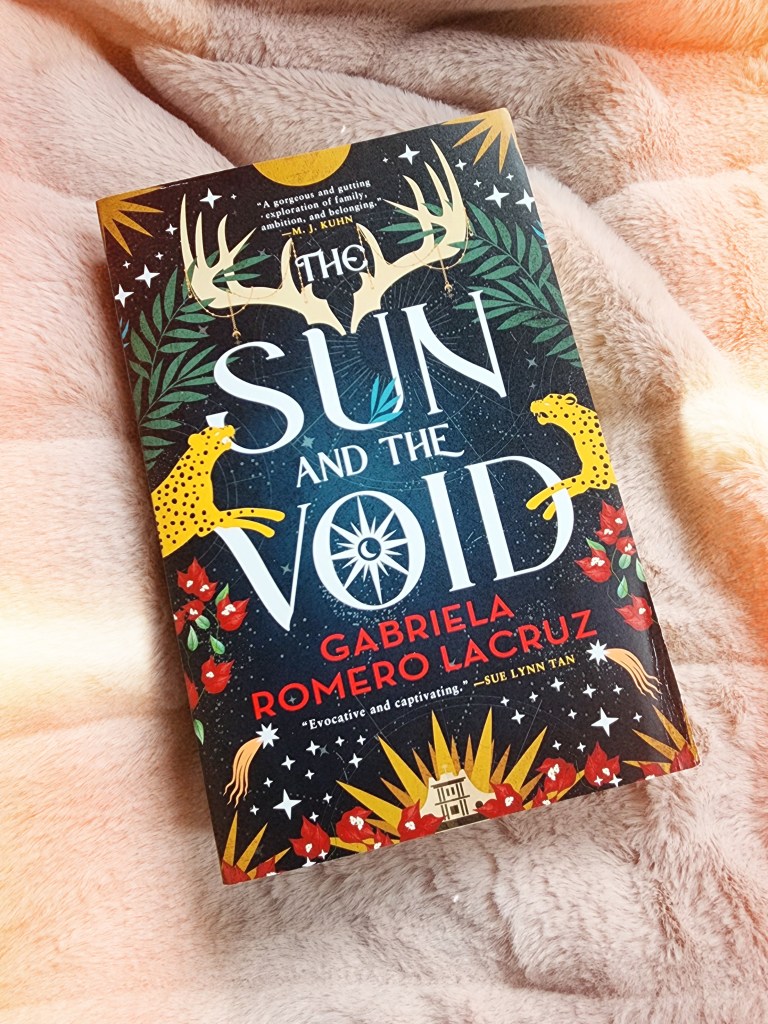
In this debut novel from a Venezuelan author, fantasy and the history and folklore of South America are woven to together to create a story that creates an ambitious story world, and explores colonialism, revolution, magic and identity. In this story, our main characters are Reina and Eva, who are both black sheep in their family because they are mixed race, and long to belong somewhere and embrace their true selves in a world and families that rejects them. The races in this world are strongly marked as different by obvious physical differences, like tails, for example. Both girls slowly embrace their magic, even though it is forbidden, and their journey walks a dangerous path.
I loved the idea of a fantasy novel that has a South American lore and own voice, and of course, the cover art of this book is very lush and looks beautiful and inviting, so I was interested to read this book. The story here has a very strong, very obvious message and thinly veiled ideals to explore, which isn’t a problem, it’s just that it can be kind of obvious and heavy handed, rather than compelling.
The book is very keen on telling you all about the world building, which makes it very exposition heavy. There’s a lot of telling you how things work and who is who, and it makes for a dense, unemotional prose, interrupting the narrative flow constantly to explain things that it might be better to just show us. It slows things down a lot and it means the emphasis is on the world building more than character development. It’s quite a flat, dry book in that sense. The idea of how that world works and all of that, is very creative and detailed, but because it’s all described in so much detail, it doesn’t feel like we’re exploring the world, just having it told at us. Like a geography class. The world, for me was displayed but I was not drawn into it.
Into this, we also have two lead characters who felt flat for me. I felt like they were quite simple and a bit naive or helpless sometimes, in a way that made them not fun to spend time with, so over all, while I like the authors creativity and passion for her world, and I can see what she was aiming for, it feels like a deeper edit might have tightened up some of the ideas and plotting, and just made the whole a bit more effective and more entertaining.
There was a bit of controversy around this book, with some people having quite a strong reaction to it, which I thought I’d be remiss not to mention. Firstly, the book has been accused of being racist, with indigenous populations in the book being portrayed as monstrous. Some people felt really put off by this, while others felt like this was used more to represent racism or colonialism, not to promote or add to it, that it was more about the authors own lived experience. The way that the two leads don’t take any agency was, for me, a problem of the book, but some have pointed out that this might be intentional by the author to show that in their lives in that place, they have no agency and therefore cannot take on agency for themselves. The author uses some turns of phrase that sometimes work and sometimes feel awkward, and when she calls sunlight “spicy sunshine”, quite a few readers out there were struck by that phrase. Some pointed out that in Spanish, there is a common phrase that if translated directly, would be something like spicy sunshine. Which then led to a rumour that the book was written in Spanish originally and then translated, which is not true. The internet is a wild place, my friends. I don’t really feel qualified to have an opinion on any of this aspect of the book, but I think if you are drawn to this book, you’ll come across this controversy, so it’s relevant to bring up.
The book is long, just over 511 pages, and there is at least one book to follow in the works, so if you loved this one, you can rejoice in going back to this story world. The book also contains character illustrations, which I liked. They felt a bit surplus to requirements, since the book isn’t illustrated all the way through or evenly through, but just in some places. But they are beautiful drawings. For me, I was impressed with the detail that the author had created for this world she is obviously passionate about, but it felt over long, sometimes repetitive and, for me, hard to sink into and enjoy. I think it needed another edit, personally.
Also, a little final warning, there are babies being killed in this book, so take that as a trigger warning as needed.
Read It If: you like detailed story worlds, fantasy and are interested in reading a book by an own voice that we don’t often hear from.
Thank you to HBG Canada for the copy of this book for review.
 CravenWild