
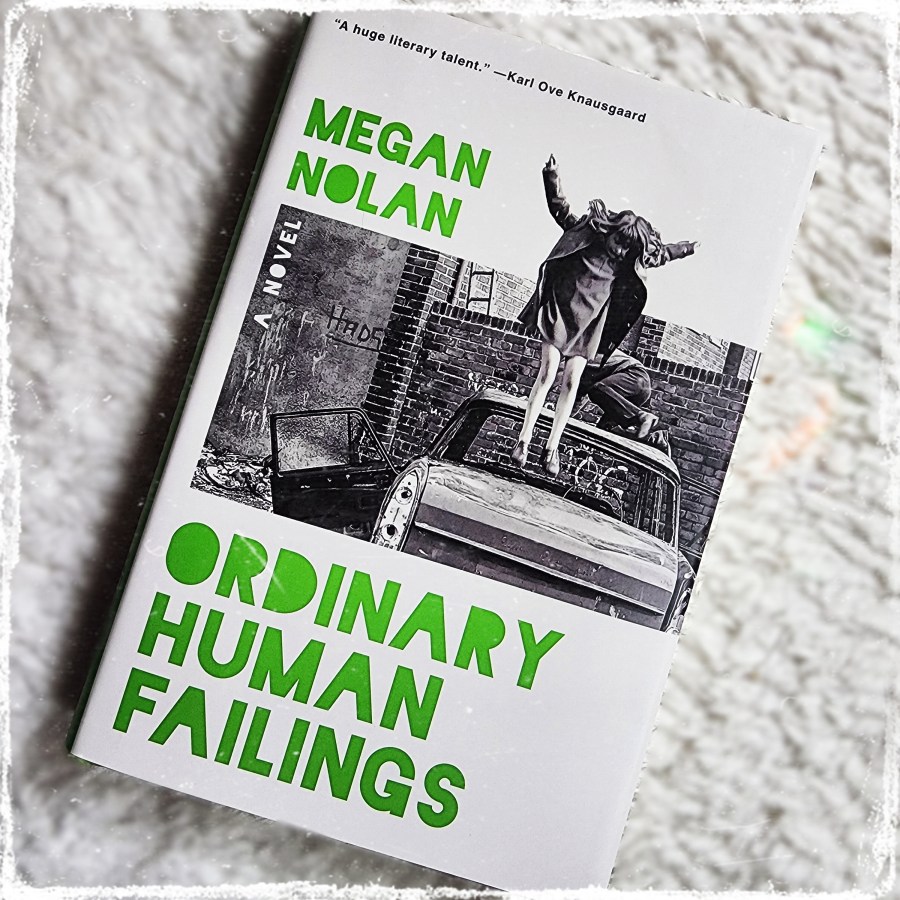

Set in London in the 90’s, Ordinary Human Failings is the story of Carmel and her family, Irish immigrants whose youngest member, 10 year old Lucy, has been involved in the death of a neighbors 3 year old on their housing estate. Tom, an ambitious and amoral reporter, hopes to exploit the story of the child’s death and her family’s low social status, and moves them into a hotel. In asking more, to find out the families sordid past, he discovers the families story of teen pregnancy, alcoholism and hopelessness, but no major secrets. The death may have been just down to… ordinary human failings.
Megan Nolan is an award winning writer, the author of Acts Of Desperation. This is her second novel.
When I picked this one, I was curious about the story of what happened and why or learning about the family’s secrets. It’s not that kind of book, in that it’s not a mystery or a thriller. It’s literary fiction that’s focused on the every day tragedy of life and character studies. Carmel is our main character. She’s Lucy’s mother, and had her when she was a teenager. And she’s the most well drawn, with her brother, father and deceased mother also explored. And we get a little about Tom, the reporter, as well. The author explores how they’re unhappy, but an ordinary kind of unhappy. They have their tragedies, but they’re everyday or not uncommon ones. Actually, it was nice, in a way, to not read about big trauma for a change. But it did feel odd to not really get more into Lucy, for example. We don’t get much much at all about how she’s feeling and what happened. We get none of the story of the family who lost a child and what the child was like, either. The author wants to look at the people on the sidelines, whose story we rarely get to see, and also the way that horrible things can happen to ordinary people without there being some huge family secret that caused it.
The book also talks a little about the way that Carmel’s family isn’t socially acceptable, and that Tom wants to exploit this to create a narrative of the degenerate Irish family and the saintly family who lost their child, which would play so satisfyingly to his readership. He looks down on Carmel and her family, and the others on the estate so as well. There is partly reason for this, the two men in the family are alcoholics, the family are antisocial and social services have been called because Lucy was being neglected by her mother.
I love the idea of this. It was a little hard to adjust at first, because I thought the book was one genre, a mystery, and it was more of a social portrait. But once I got into it, well, I really liked the way the author writes. But it’s not wholly successful in what it wants to achieve. It feels almost callous the way that the book ignores the awful and tragic events at it’s heart, and the family effected. Especially as the author is at pains to point out that the reporter is amoral for not caring about the people he writes about.
The set up of having an interesting case at it’s heart means that you want to know more about what happened. It’s dissatisfying to not find more here. It’s like putting the gun or the knife in the first act of the play, and then not using it. It doesn’t completely work. But I do think it’s an interesting idea, to focus on the ordinary people involved, or ordinary families, that are often lost or even dehumanized in the headlines.
On another level, I didn’t really like any of the characters. I liked the way the author wrote them, and they’re all well drawn, but they were generally quite self involved and selfish. It can be hard to read about characters you don’t like, even if you do understand why they are that way. A child has been killed and Carmel’s father and brother are only thinking about their own wasted lives and the next drink. And Carmel is not all that worried about Lucy. Her child is a stranger to her and she’s thinking about the love she doesn’t have, not about the love she could be giving. And Tom is a bit of a typical newspaperman villain, using everyone and looking down on them.
So, I’m in two minds about this one. I think the author was trying to do something different and exploring something, and while it wasn’t wholly successful, it wasn’t entirely unsuccessful either. And I liked the point that the book makes about the way that there is no big family secret that caused the death of the child. Tragedy and death, even murder, can happen out of ordinary circumstances as well as extraordinary ones.
I hope that some of you do check this one out. I think some of you might find it interesting. I’m very interested to see what the author writes next.
Read It If: this one is for lovers of literary fiction, character studies and UK authors. It’s something different and the writing itself and the concept is good.
Thank you to the publisher for the copy of this book for review.
 CravenWild