
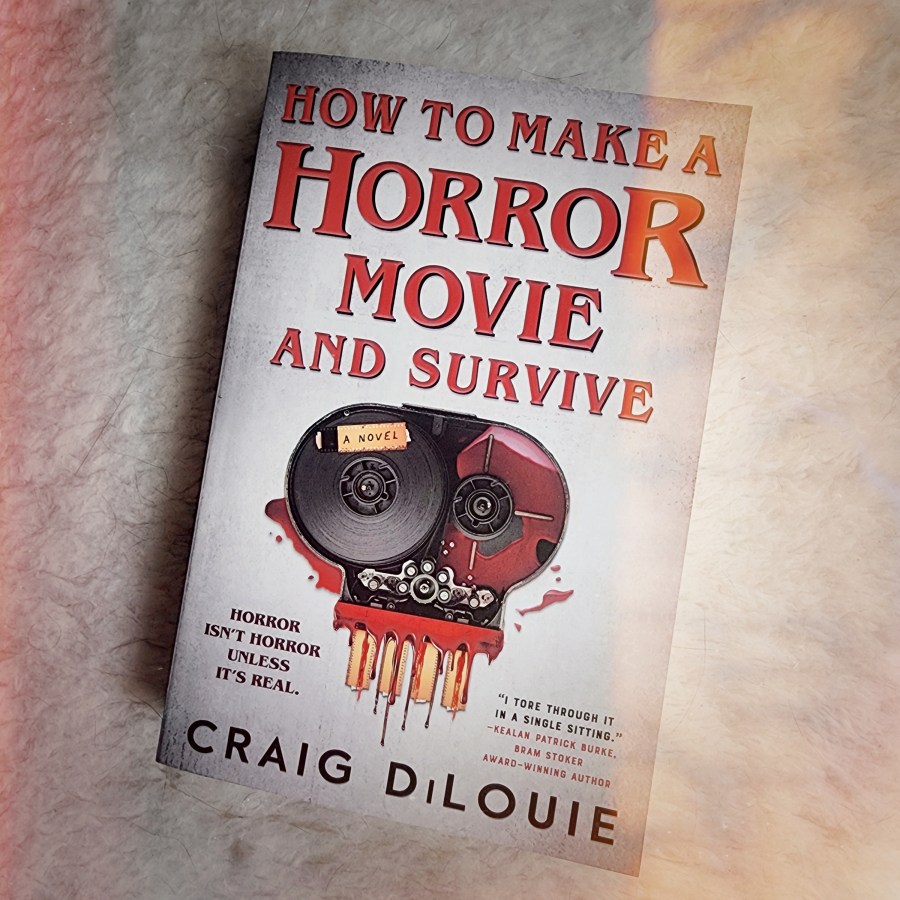

The new Craig DiLouie is here and this time he’s exploring the nature of horror and why we’re drawn to these stories. How To Make A Horror Movie and Survive is set in Hollywood in the 80’s, where movie director Max has just made Jack The Knife III, the latest in a very successful slasher franchise, but he hungers for more success and to make horror that will really scare people. At the wrap party, he meets Sally, an actress who wants to be a star and a horror movie Final Girl, and the next day she takes him to an estate sale of a deceased movie director whose cast all died on the set of his last film and who has lived as a recluse ever since. There he finds the cursed camera that that film was shot with, and he finds himself compelled to buy it and use it. Maybe he can finally make the horror film of his dreams and the stuff of true nightmares.
I really enjoy this authors books. I have also reviewed Children of Red Peak (HERE) , about a cult, and Episode Thirteen (HERE), about a haunted house reality TV show. While his books are fun as horror reads, he has good pacing, characters and interesting themes, what sets his books apart are the little forays into speculation or philosophy. It’s not trying to be artistic or anything, which would probably take the fun out of it, it’s more that the author likes to play with expectation and make you think, or leave you to decide what the ending means sometimes. It’s a nice signature to his work. In this book, as I mentioned above, he’s interested in why horror movies are perennially popular and why we don’t want real life horror, but we do love to be scared. Why is it fun? It’s also a love letter to horror cinema, with the film being the story of the horror movie from idea, pre-production, through the process to the screening of the film.
The choice of setting the book in Hollywood in the 80’s is a nice choice. It’s an era of excess and where slasher horror was big business, but in many ways had jumped the shark, having increasingly ridiculous and gory deaths and sometimes making the audience laugh at the absurdity of the venture as much as scaring them. This is the era where sequels upon sequels were born, and the idea that every film needs to be bigger and better, but also mostly the same, really came into play. This book to explores not just the classic slasher horror of the era but also the callous nature of sensationalizing violence, the stunts and the gore, and what they symbolise. It makes a great premise of the book. It’s an homage to these movies, with gore and schlock, but also pokes a cynical finger at the way Hollywood cashes in on things, like the audience desire for more and also the audience desensitization, that people might want to see horror movies that they think contain real life horror, real deaths or real monsters.
So, has Craig DiLouie done it again? I think this is mostly a very successful book. I don’t think he goes too far in exploring why we love horror (those of us that do, anyway). It could be really dry and academic if it was just a treatise on the human condition or whatever. And I think the way the book covers Hollywood and the horrors of working in the industry, the shallowness, the casting couch and getting things greenlit, is quite interesting. There’s a lot of insider things, like how things work and mentioning or referencing other horror films, which can feel a little Horror 101 at times. Maybe a little factual. Joseph Campbell and Grand Guignol, which Arriflex was the heaviest and what’s in Max’s contract. Personally, I mostly liked this, but I wonder if other people will find it a bit dull? If you know a bit about the horror genre or filmmaking in general, this is not going to be new facts to you and if you don’t, you might not be interested. But it does make sense for the realism of the story and even for the way that Max, the horror director, would think. It’s the story’s world, after all.
What really does work well is that the story is a lot like a slasher film itself. Not the plotting exactly, which follows the steps of making a film, with filming itself being the shortest stage, the climax of this book, but we have a cast of characters, we have a mad scientist type, a final girl, and gory deaths worthy of any slasher franchise. I liked that the author managed to make Max, who is pretty sinister, and Sally, who is pretty self absorbed, also be somehow fun to read about and sometimes even sympathetic. I thought that was well played. I loved the cursed camera! What a great idea. I don’t want to tell you too much and spoil anything, but I like how it whispers to Max and the story behind it feels reminiscent of a few famous cursed horror movie objects, thinking of Christine and Evil Dead, as some examples. It feels like something you might find in Ed and Lorraine Warrens or Zach Bagans house. Great idea.
I also think that there’s a bit more humour here than in some other Craid DiLouie books, which is a nice touch for the ideas in this book. Old horror films are often funny to watch now, the scares being pretty tame, and some of the horror films of the 80’s slasher era really were meant to be darkly funny, which is something that this book talks about. Sometimes it’s Max being cynical, or someone dropping a funny one liner, other times it’s a gleeful dark tone in a scene or the way that something turns out ironically or doesn’t work out for someone. Or even the way the author pokes fun at Hollywood and it’s shallowness. I think this was something that worked really well here and was not overused, but just added like salt on top of popcorn.
On the whole, I enjoyed this one. I love horror movies and slasher movies, and this book reads like one. I also love old Hollywood stories and lore, so that was up my alley as well. I think this was a fun read. I do think some people may not love the facts peppered in, but the deaths and the gallows humour might make it up to them.
Read It If: this one will please most horror fans, I think, but especially slasher horror movie fans and fans of the author. I liked this one.
Thank you to the publisher for the copy of this book for review.
 CravenWild
Pingback: My Ex, The Antichrist by Craig DiLouie – CravenWild