

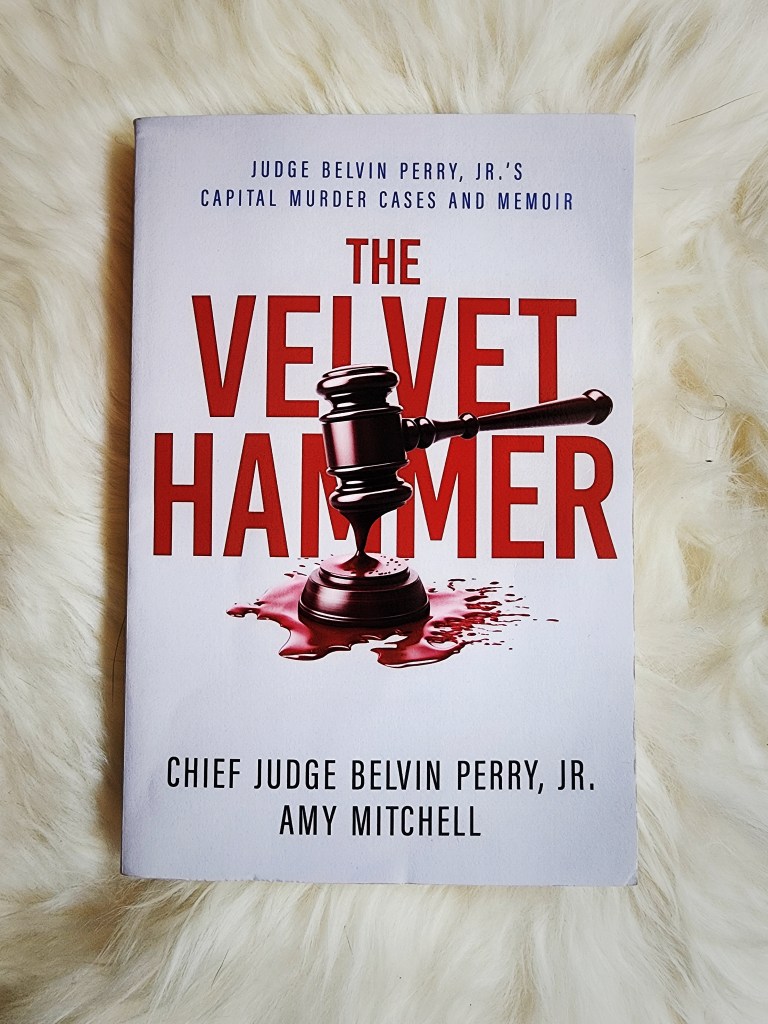
Judge Belvin Perry Jr was nicknamed the Velvet Hammer during his time as chief judge in Florida, so called because he had the soft ease of velvet in the court room, but also served justice hard like a hammer. In this book, co-written with Amy Mitchell, he talks about his varied life experiences, from growing up in a strict but loving household in the segregated South, to finding his way into law as a young African American student, and onto serving as a prosecutor, chief judge, private attorney and beyond. He famously presided over the Casey Anthony case, which launched him into the public eye, but he also worked on other capital murder cases and sought the death penalty in many cases. In this book he shares his life with his reader, as well as details of some of his most intense cases, including details of the Casey Anthony trial, and also his view on the law, his profession, and why he believes in the death penalty.
I was drawn to this book because I felt like it has a different perspective than we often get as true crime readers. We often have books by journalists and researchers or podcasters, victims, even lawyers, but we less often hear from judges. I thought this was an interesting angle. And of course, Judge Perry himself is an interesting person.
It’s worth noting that while true crime makes for fascinating reading, it’s not for everyone. This book talks about race and segregation, some truly tragic and violent cases, and the death penalty. I don’t think this will surprise readers of the crime genre, but it may not be for you if you weren’t expecting that kind of thing in a memoir.
The book reads really well. It’s a very smooth and flowing read, which means you may be up turning pages after lights out. It’s mostly structured very well, with famous cases being interspersed with chapters on Judge Belvin’s life. It gets to Casey Anthony (a high profile case, Casey was charged with her young child’s death after she didn’t report her child missing) pretty early on, as well as some of the other better known cases he worked on, like Judy Goodyear, a black widow, and then later in the book he goes into the Anthony case in great detail. It was a case that launched him into the public eye, and the one he’s most publicly known for, but I did feel at times that it was over referenced. It feels redundant to bring that case up in chapters that are not directly about it.
While the cases are very compelling reading, I really liked the stories from his personal life. He grew up in the 50’s, his father was one of the first African American police officers, and his mother disappeared from his life one day when he was young due to mental illness. He’s also blind in one eye from an injury obtained during a game of Robin Hood played with real knives when he was six. I really loved how he spoke about his father, who was clearly such an inspiring presence in his life, and someone he looked up to. You can see how it has shaped his life and his outlook. Because he worked in the legal system for his whole life and a long career, the book also detailed how he’s seen the system change, from electric chair to lethal injection, from no women on the bench, to more of them entering that arena. I really enjoyed this perspective and learning about his experience.
As mentioned above, he sought the death penalty in certain cases, and I think he spoke about this in this book so well. He’s not really out to change minds or justify himself, but he explains how he was initially against it, and then came to change his mind, and why he thinks it’s the right sentence in the right case. I wonder how I would feel about it if I presided over the cases that he has and had seen the things he’s seen. He makes a case that I think is relatable, and he answers or acknowledges a lot of the arguments against the death penalty. I’m not going to talk about what my opinion on the subject is, because I don’t live in the US, and have never lived in a country that has the death penalty. But I think that the way that he makes his points, whether you agree with them or not, are well reasoned and calmly put. He’s not closed minded and I respect that.
On the whole, its a read that I enjoyed. It’s structured a little oddly. The back half is very detailed on the Casey Anthony case, and I think it may have worked better to have a Part One, Part Two divide, with the memoir more focused in the first half. It feels well organised as you read it, but just not the ideal structure, perhaps. But that aside, it’s very interesting reading. You really get a sense of Judge Perry, his own voice comes through really well, and while I don’t agree with all his opinions, I found myself liking him quite a lot. He’s hard working, honest and principled, and he walks the talk. And I think that curiosity of mine about the different perspective, of a judge presiding on murder and violent crime cases, is satisfied here. It’s something different and a good read about true crime and a fascinating life.
Read It If: you’re a true crime reader or like books about law and the legal system, or if you were transfixed by the Casey Anthony trial. Trigger warning for biography readers. Overall, much enjoyed.
Thank you to Post Hill Press and Amy Mitchell for the ARC of this book for review.
 CravenWild