
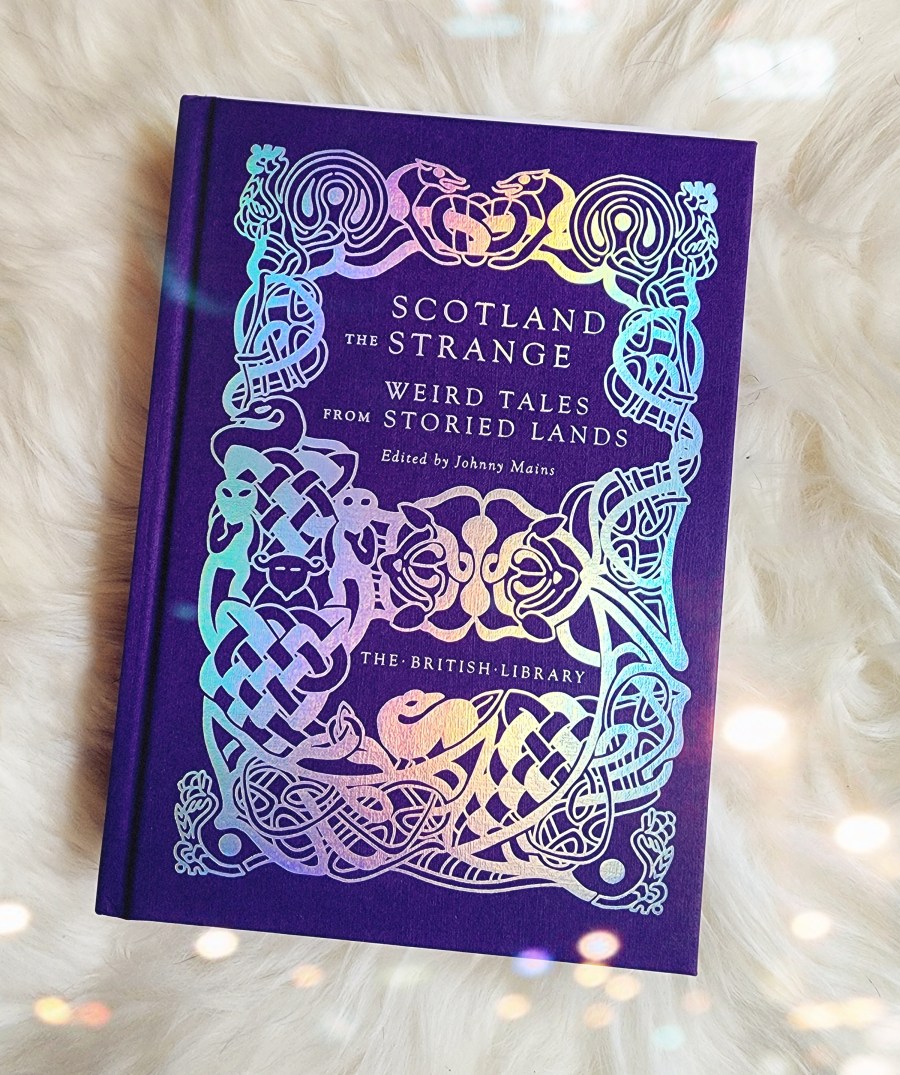

This stunning volume is Scotland the Strange: Weird Tales From Storied Lands, one of the latest in the Gilded Nightmares Series from The British Library. I love this series and have quite a few from the collection. They feature beautiful binding and cover art, and each one contains horror or ghost stories collected around a theme or an author. Because of the British Library’s excellent and extensive catalogue, and the editors brilliant research and curating, the stories are often rare finds and feature previously hidden gems for the avid horror reader.
In this volume, the editor Johnny Mains takes us through a history of weird tales from Scotland’s literary history, from the early days of publishing to more recent fare, foregrounding his own experience of growing up in that country and the way it’s culture was often subsumed under English or British in his education and upbringing. The book is also scattered with lovely small illustrations in black and white that match the cover, and make the reader think of moss covered carved standing stones, and the stories are rich in atmosphere, from heather and brae to mists and thunder, fishermen and witches.
The term “weird” or “wyrd” is most appropriate in this collection. While previous volumes were more clearly ghost story collections from authors like MR James, Edgar Allen Poe and Bram Stoker, some recent volumes have been collections based around place, like Celtic or Irish stories, and this book is in the spirit of those volumes. In this book, we have stories from 1818 to 1976, each story featuring a short introduction about the author and the relevance of the story or a little context if needed, and features short works from James Hogg, Robert Louis Stevenson, John Buchan as well as other classic and some lesser known writers. The weird aspect of the story is often a strangeness or some kind of curse or dark magic, rather than straight ghost stories. Some of the early stories in the collection had more of a dark fairytale style to them, making me think of the witches in Macbeth, for example, and then as the stories reached the more modern period, ghosts and strange occurrences were more dominant.
Some of the previous books in the collection being more classic style ghost stories in the British tradition, means that this entry in the series feels slightly out of step to me. If you bought this looking for a spooky read, it might be slightly too soft and not as satisfying. However, I did really like the editors commentary about his experiences growing up in Scotland and how he felt for a long time that there was not as much of a literary tradition of Scottish writers, because of his school curriculum’s focus on English and other writers. The book reflects him discovering an obscured roster of Scottish writing and authors, and especially in this weird or spooky genre. The problem as an outside reader is that while the early stories included are interesting for that reason, for the general reader, they don’t feel very strong and intriguing compared to other collections in the series. They’re dark fairytales more than horror, really, but they do, I will admit, fall under the tradition of Scotland’s weird tales or even Scottish preoccupation with witches. However, as the book goes on, some of the later stories in the series are really good, some even excellent, and it would be a shame to miss out on reading those.
On the whole, it’s a really interesting look at examples, and perhaps more pertinently, rare examples, of Scottish writing through time, from early days of publishing in the early 1800’s to recent times, and I did really enjoy the book as a whole, as a trip through time and evolving literature. I’m glad to add it to my collection, but I think it may not be my favourite volume in the series as a whole, just because it’s not as horror heavy as others and doesn’t strongly fit the series as I would like. (Perhaps a book on stories of Scottish lore and haunted places would have worked better? Burke and Hare, after all, make a classic and all too real Edinbrugh horror story) A good book on it’s own merits though.
Read It If: you love Scotland, and it’s stories and authors. It does have an eerie and spooky tone, and is a good overview of the evolving literature of that genre, but if you like more traditional ghost stories or spooky stories, it might not be for you.
Thank you to The British Library and IPG for the copy of this book for review.
 CravenWild