

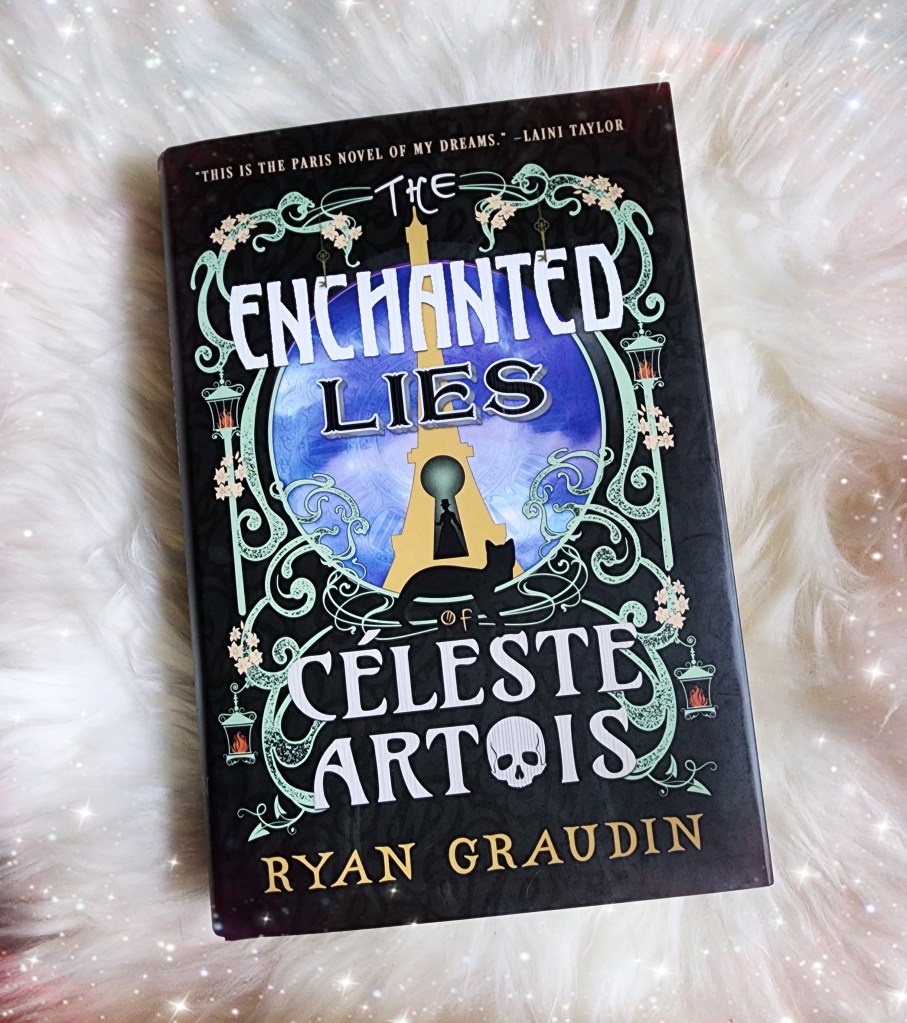
This book opens with an introduction speaking directly to the reader that goes for a few pages, letting us know that not everyone can see magic. Some people are mundane and aren’t special, and those unmagical types will not like this book. It reminded me of The Emperor’s New Clothes. If you like this book, it tells us, you’re not like the others, you’re special and magical. You can see what others can’t. It also made me think of the phrase “you’re not like other girls”.
The book is set in 1913 Paris, and we have three main characters, young girls who call themselves The Enchantresses and who work as forgers and thieves, and live of cheese in a graveyard, where they are blackmailing the keeper. Celeste had dreams of being an artist, but now works as a forger, and when she meets handsome Rafe, he draws her and the other Enchantresses into a world of magic in a hidden world within the city. However, dark magic is curling at the edges of Paris, and Celeste may not have much time left, as she succumbs to consumption.
The book has magic, lush world building, a talking cat, the lights of turn of the century Paris, the Romanovs and more.
This one as a bit much for me. After that opening, we come across Celeste wandering the graveyard feeling bad about being a criminal, but also feeling completely justified in stealing from others. Her guilt feels performative because it takes place dramatically in a graveyard in Paris at night, and also because it’s clear that she revels in getting one over on her marks, and is proud of duping others and how clever and powerful it makes her feel. There’s no real shame or guilt demonstrated, or any acknowledgment of how her actions harm others. If you’re going to make a character morally ambiguous, you must also make them sympathetic or interesting in some way, funny perhaps, or we must know they are going to be held accountable. So this doesn’t really work. Quite a few of the characters in this book suffer from being a little to thinly drawn or just not interesting enough.
When that happens, sometimes the world of the story can make up for this. For me, this version of Paris felt like it was a little inspired by Disney or teenage dreams, or at least a very romantic idea of the French city, and I don’t mind that too much. It’s a fantasy novel after all. But I do think that it doesn’t always work very well. Trying to be edgy by mentioning absinthe and women who can street fight misses the mark somewhat. I think the addition of the Russian element was unnecessary and not handled in the most entertaining or accurate way, as well.
I think the hardest part of this book for me was the language itself. There’s a phrase early on in the book that is a good example: A cheese knife is described as being dull enough to make the Camembert taste sharp. I get that to some people that may sound clever, but it’s just flowery. It means nothing, since we know a knife doesn’t affect the taste of the cheese, sharp makes me think of cheddar and not Camembert anyway, and it adds nothing. It’s just meant to sound cool, but it’s nonsense. There’s a lot of this added frilly language in this book, and it’s really annoying. The book is long enough as it is and nothing happens a lot of the time, so this kind of verbiage gets pretty grating.
The inclusion of a cat couldn’t save this one for me. I wanted to like it, it needs a serious edit and to be a lot shorter. I know some people loved this book, so please don’t be offended. I really wanted to like it.
Read It If: this one is being billed as aimed at adult readers, I feel like it’s YA and might appeal more to YA fans.
Thank you to HBG Canada for the copy of this one for review.
 CravenWild