

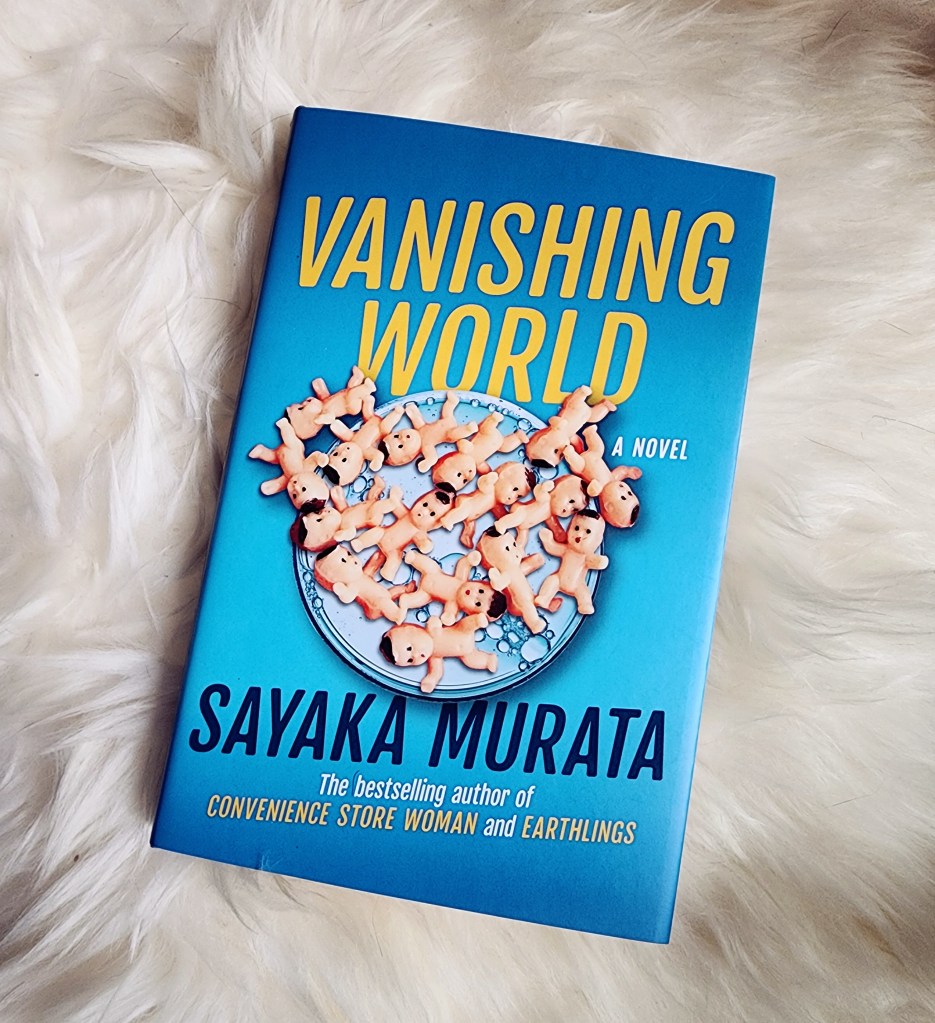
(Translated by Ginny Tapley Takemori)
Following the massive loss of life of WW2, women helped the war effort by being artificially inseminated. With the biological need for sex eliminated, it started to be considered unclean and incestuous, though people still marry to raise children and people vent their romantic feelings on commercialized romantic cartoon characters. As science evolves, the question arises whether the family system is needed at all, and soon men will be able to give birth too. Into this world, Amane is born via old fashioned, human to human contact, with her mother raising her to believe in romance, love and physical connection, but she wants to fit in to the world around her and be normal, even while she’s out of step with her peers: she sees herself as a reverse Adam and Eve, rather than the first to sin through sex, she’s one of the last.
It’s a little hard to describe the plot of this book. It’s not very long and it’s a portrait of Amane and her world, rather than having a lot of plot points. I don’t want to spoil things by saying too much of what happens, but it’s a slow build over the course of the book. We see her grappling with being repulsed by her mother’s view of the world, her old fashioned ideas of physical connection, and yet she ends up embodying some of these old ways of being, and we see her struggling to relax into the world as it is now. Sometimes other people strike her as very strange and gross, as cultlike or more adapted to the new world, other times she wants to almost merge with them. It’s all building to a dark crescendo, which is one of the things that this author does so well.
Sayaka Murata is an award winning Japanese author who has written several popular books in her native country, before bursting onto the English language scene when her tenth book, Convenience Store Woman, was translated into English. This was followed by Earthlings, which we reviewed HERE. Her books are something quite different. Earthlings and this book are about women alienated from society, struggling to understand it, and they’re both confronting, unsettling and strange stories, but in the best way, not just for the sake of it. Her books tend to explore themes of taboo subjects, social conformity, asexuality, and the struggles of the modern world, like climate change or concerns around birth rates. This can lead to uncomfortable reading. I’d say this book is fairly graphic, though perhaps what’s most unsettling about it is the oddly clinical nature of the way that things are described. It’s a thought provoking but unsettling read that I was left thinking about long after reading. I think this author may be a little bit of an acquired taste.
Personally, I’m always fascinated by the ride Murata takes us on. It’s always weird, but the way she writes is page turning. I think this idea of disrupting the traditional conception of babies is a long held debate. I remember the term “test tube babies” used to be thrown around, and the idea that men might feel obsolete if women could conceive without them. In this book, the idea is taken further and further. What does love and romance mean if we don’t need it for procreating? What does family mean? Does gender matter so much in that space? Do we need any of these concepts? What would life be like if it was organised around these controlled principals? Because of this concept of having children divorced from sex, we have this clinical sense of need and closeness, feelings and bodily needs just need an outlet and to be ignored. It’s creepy and sterile, but on the flip side, by making some of the language cold and distant, the author is able to show us how Amane feels apart from people, even a little disgusted by some people who get too close, and then wanting to be inside the bodies of others. It’s very strange, and yet I could see some parallels to modern life, just taken to an extreme, taken into the zones that we don’t talk about. It’s not so much about the anxiety of social breakdown in a changing world, but rather about the way that top down societal norms can be put upon us, and their inhumanity can be maddening and insupportable.
On the other hand, Amane’s story shows us our own world turned upside down, which does highlight how weird it is to be human. In a dark way, I found some of this book quite funny, things turned upside down and inside out. The way husbands and wives are so OK with their partners having lovers was a bit funny. The way that new ways of being are seen as more evolved, and then someone else seeing their way of living as being even more evolved and the previous trend is then seen as primitive. Competitive social evolution, I’m more evolved than you, feels relevant. And the way that anime characters are designed to capitalise on people needing an outlet for their romantic feelings, which then leaves people feeling exploited, this is so cynical but feels hilariously likely. At one point, the book says “Normality is the creepiest madness there is. This was all insane, yet it was so right.” I think that’s what this book is really exploring.
I did think of stories I’ve heard of children raised collectively, usually in the modern era as a means of the state breaking up the nuclear family as a social construct, as part of something like a Marxist or Communist ideal of state before individual. These were stories I have been told anecdotally by friends whose parents or relatives had experienced it and how damaging it was, and on fact checking myself, I could only find one instance of it in this Guardian article HERE. It’s something that has been tried before, and it’s also something that seems to be common in cults as well. I wonder if this was what inspired Murata?
Either way, this is a book that may not be for all of you. Murata can be an acquired taste because of that confronting or transgressive and unsettling story telling, but if you’re OK with that and like a more arthouse kind of read, it’s startling and fascinating reading. And the ending in this book… It gets dark. After finishing this one, though, I went onto my local libraries catalog to reserve Convenience Store Woman, because I haven’t read it yet, and found I’m 17 on the list to read it.
Read It If: you’re a fan of this author, you’ll love this one. If you like a read that’s challenging and thought provoking and can handle a little body horror type visuals and concepts. There’s nothing quite like this Sayaka Murata.
Thank you to PGC Books for the copy of this book for review.
 CravenWild