

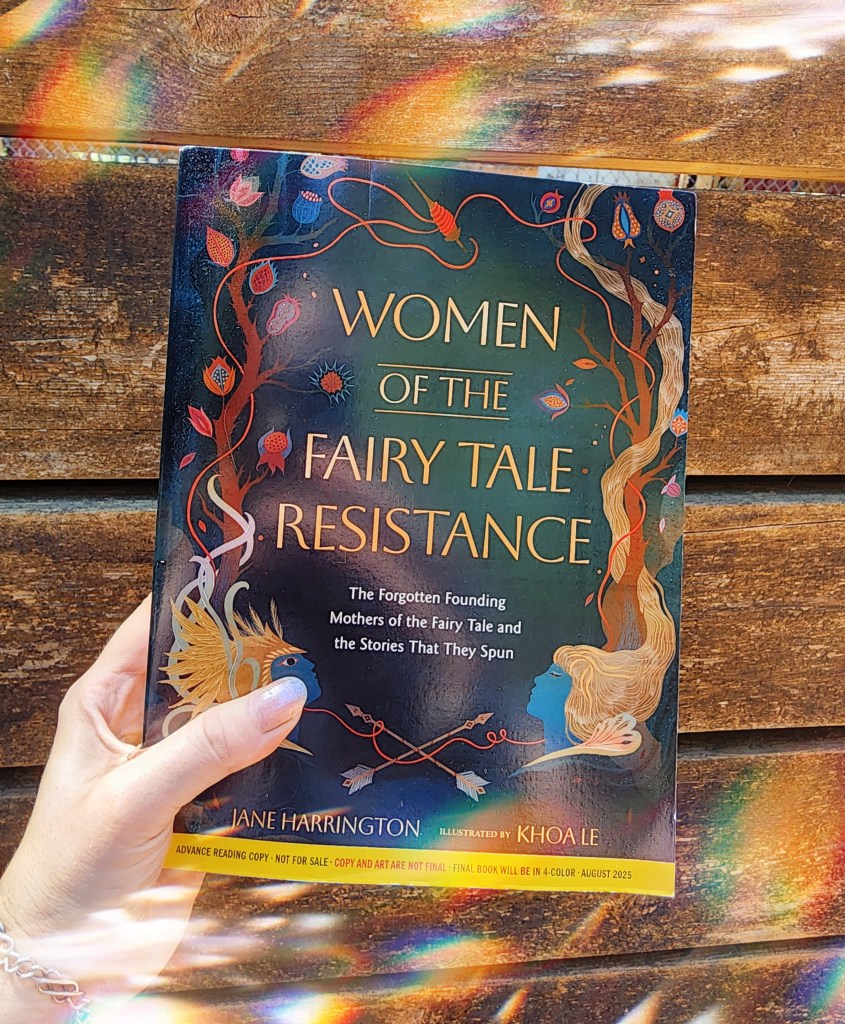
“The forgotten founding mothers of the Fairy Tale and the stories that they spun”.
This pretty book sets out to tell us the personal stories and some of the output of Les Conteuses, a group of literary women in the French Upper Classes, who wrote in the era from 1690 to 1709, and who wrote nearly two thirds of the fairytales published in the region at this time. They wrote their stories for each other and other members of their salons, where the stories could be read out loud for amusement.
The book is bound nicely, with illustrations throughout by Khoa Le, and has different chapters for seven of these authors, opening with a biography of each, and following with examples of their work, rewritten by Harrington.
I didn’t love this one. While the layout and design is very appealing, the book suffers from a few problems.
Initially in the introduction, the author picks and chooses history to skew it in the direction she wants to go in: that these women were persecuted, men were universally bad historically and stole their ideas, and that their stories were feminist and therefore buried. The women referred to have been much studied, so they’re hardly forgotten, and the Grimm brothers, for example, were anthropologists collecting German folk tales that were being lost to time, and reflected a growing interest in valuing what was then popular culture. They didn’t claim to write them. Perrault didn’t steal their ideas either, he was part of their literary movement, in fact.
The book speaks with confidence about the biographies of these women, sometimes speculating about their sexuality and playing up the dramatic parts of their lives. It’s funny that these women are conveniently co-opted at feminist and LGBTQ+ friendly, when they were also very wealthy, and you could just have easily argued that they were exploiting the lower classes in order to have the education, time to write and the salon to share it in. And you could argue this because while the book speaks in a strident voice about this, the fact is that not a lot is known for sure about these women, so you can estimate a lot. In fact, the book has no extra information than the authors Wikipedia pages. In some cases, I think you could argue that one or two of these women might have been openly gay or bisexual, (one of them was accused of it) but my point is that when we try to put modern political movements like feminism or modern understandings of gender and sexuality backwards onto history, we generally lose some of the nuance and context of the era. And of the people we’re studying. It’s not good research to speculate in this way.
As someone who is a Feminist and who knows women are equal, and who is not in denial about the fact that people historically have always been gay, lesbian, asexual, etc, I don’t think we need to omit truths or leave facts out, or speculate in order to reflect this. When you do that, it’s called propaganda, even if you are on the correct, good side, as you see it.
I also think that the author re-rewriting the stories to have her edgy little asides in them means that the book has an overall matching writing style, but means that we lose the unique voices of the different authors. You could argue that this can happen in translation anyway, but it doesn’t with good translations. I think it would have been lovely if the author had tried.
Read It If: this one might be more for teenage or YA readers, I’m assuming it’s aimed at them from the writing style. If you’re looking for more depth of research or a more academic book on Les Conteuses there are some really good ones out there.
Thank you to HBG Canada for the ARC of this book for review.
 CravenWild