

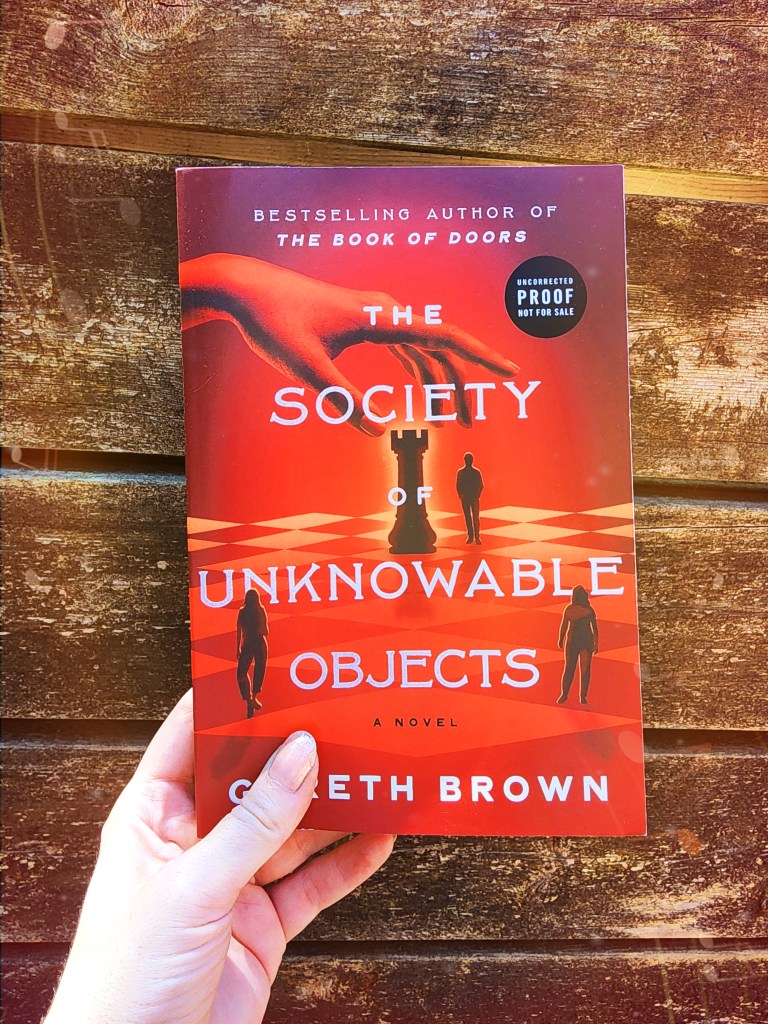
In the basement of a bookshop in London, a secret society meets twice a year, guardians of an archive of magical items that look like ordinary, everyday things, which they call Unknowable Objects. Their aim is to hide the magic and never use it, because absolute power corrupts absolutely, according to their leader and oldest member. When a new artefact seems to have surfaced in Hong Kong, newest member Magda Sparks is drawn into a deadly game that plays out across the world, and will make her question the truth and everything she’s been told.
This is the latest book from Gareth Brown, who wrote The Book Of Doors, which is set in the same story world as this book. This is a standalone novel, but there are small references or Easter Eggs for the discerning eye who read the other book. It’s a very nice looking book, if the ARC is anything to go by. It has a dark academia look, with illustrations on the section break pages and little artifacts decorating the top of the chapter pages.
The way the world of magic works in this book is quite nice. I won’t spoil anything here, but I liked that the magical objects look like ordinary things, a chess piece, a scrap of paper, dice, and that your senses will tell you they’re magical: they have a hyper-real look to them and a heaviness when you pick them up. Kept in a cabinet of tiny drawers (can you imagine? Like old card catalogue drawers. Heaven) which has an elaborate closure, leading to it being called the Clockwork Cabinet, the archive is kept but not used, though as we learn, members of the society sometimes keep one or two for themselves… Like Imelda, our heroine’s mother, who has an Atlas: a piece of worn looking paper that works a bit like a Marauder’s Map, changing to help her find magical objects in the wild.
The key thing is that if any of the pieces fell into the wrong hands, the power it gives one person could make them unstoppable, which is essentially what happens in this book. And I think that makes for a fairly interesting plotline. The book, though, constantly moralises for the audience about how using the objects is bad, though they do not, in and of themselves, corrupt people, and that repeated message gets a bit dull after a while. It also takes all the fun out of the whole thing. Like if Batman gave away all his money and didn’t help anyone, or if Sabrina decided to just not use magic at all, and be a teenage non-witch.
There’s something a bit slow about the writing style, it tends to repeat itself a little and describe too much. The villains backstory could have been one page, and a walk through a park in Hong Kong adds nothing. Imelda’s perspective could have been cut without us really losing anything. There’s a letter included from one character which repeats a bunch of things we already know. It gets a little cluttered and winds up feeling somehow lacking in substance at times.
I think the style overall is dark academia meets Robert Ludlum, it has commercial thriller elements and also bookshops and rain and secret societies. And I think this worked pretty well. I did find myself wanting to finish is and enjoying the general vibe, but it could have been tighter, a bit more entertaining, more tension, and maybe not so “worthy”. A little lacking in subtlety and nuance, which I think a lot of books do these days.
Read It If: give this one a try if you like dark academia, it has it’s charms. If you read the author’s previous books, you may like this one.
Thank you to Harper Collins Canada for the ARC of this book for review.
 CravenWild