
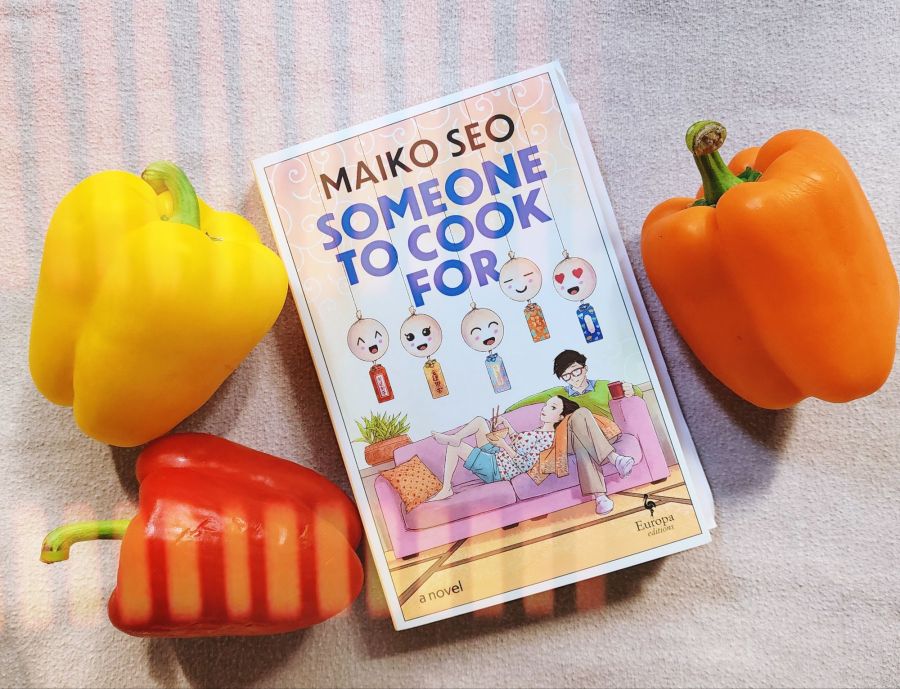
Translated by Laurel Taylor.
Yuko is an ordinary, happy little girl, though she was raised in an unusual way, with a succession of foster parents, all of whom loved her very much. The book follows a year in her life, as she reaches her last year of high school, and faces moving out into the world as a young adult. The story also winds back to tell us the story of who all her different parents were and how she came to live with each one, and what each of them gave her as a parent. In her current home, she lives with Mr Morimiya, who loves to cook for her, though his offerings can sometimes be a little unconventional.
Someone To Cook For is a warm and gentle story, sometimes funny or poignant, about the places we feel at home and the way found family can be as strong as biological.
Maiko Seo is the author of several very popular books published in Japan that have been adapted into TV shows and films. She has been translated into many languages and this is her US debut.
Early on in the book, Yuko is a young kid at school and she senses that the adults around her, especially teachers, expect her to sometimes have problems and they ask her about it, asking her if she needs to talk, leaving her feeling like she’s letting them down by not having any. Her tragedy is her ordinariness. This was so human to me. This wish that children have to give adults what they want and expect, often without the wider context of meaning, and also adult’s desire for a bit of drama, sometimes feeling disappointed when there isn’t any.
Not to put too fine a point on it, but in the West at the moment, everything is about personal trauma and it’s often overwritten to the point of meaninglessness in books that all characters are driven by trauma narratives. This book feels incredibly refreshing and down to earth by comparison. Yuko is OK. She’s had a series of parents who love her and she’s heading out into the world happily.
That’s another thing about this book, and other Japanese books that I’ve read, that’s incredibly refreshing. While the drive to do well at school and things like that seems to be quite high (and the demands of office jobs are on a whole other level), there’s a sense that doing well is less ambitious than in Western books. Here, Yuko wants to go to a good grad school that gets her to where she wants to go. And that’s healthy. I’ve noticed a lot in stories like this, the pressure is there to do your best at your job, but the obsession with being the best is not there. Someone opens a restaurant in this book, and the plot is not about working yourself to death for success or being a master chef. Success is not about attention, here, like a huge opening day, or outselling a rival, or opening a franchise chain and making millions, or famous people eating there, or getting into the best culinary school or proving something to someone. Success is that you did it and it’s sustainable. You’re content, proud of your work and doing a good job. It seems to simple, doesn’t it?
There is some personal drama with friends in this book, and it’s interesting the way that Yuko handles it and feels about it, but on the whole, it’s quite a gentle story with benign people in it. I loved Mr Morimiya, her current father, who is sort of hapless. He clearly really loves her and wants to get being a dad right, but it makes her see him as a little weird, which is funny. It’s such a teenager reaction to think our parents are weird. I loved all the descriptions of the different foods he cooked her and how they brought each other cake and things. He makes her katsu don for breakfast on her first day of school, and I don’t know if that’s normal breakfast in Japan, but I don’t think it is! At one point, he goes through a phase of making all kinds of fruit jellies. It’s such a lovely household.
The way the story is structured is a little like a mystery. As some chapters take us back into Yuko’s story, we learn how she came to each parent, and we get little hints that keep us curious. Rika, her step mother, disappeared? We find out her biologial father is still alive, where is he? It makes for a very hard to put down story, as we get different parts of her life, fitting like puzzle pieces and sometimes being quite strikingly unusual.
Towards the end, as these threads come together, I was quite struck with the way that it all played out. It’s hard to talk about without spoiling anything, but Rika’s decisions are quite odd and Yuko’s lack of curiosity was really strange to me, too. I’m not sure if something was lost in translation, in the sense that maybe the actions and choices here make sense in the context of Japanese culture or society, but I don’t think I’d see it all or take it quite as casually as Yuko does! But that said, it’s still a heartfelt and satisfying ending to the story, and one that feels realistic to the characters as we know them.
At this point, whenever I see a book from Japan that’s translated into English, I’m picking it up. I find them so different and a bit less fraught than Western novels and I love all the little things I learn as I read them. (This book made me hungry too!) Some are more intense (looking at you Sayaka Murata) and some are more gentle (What You Are Looking For Is In The Library, or HERE) but they’re all so interesting to me.
This one I highly recommend. It’s a really interesting story, with a hint of mystery around Yuko’s past, its poignant and kind hearted, I love the father/daughter relationship and overall, it’s a real page turning read.
Read It If: order yourself some takeaway (Japanese cuisine, perhaps?), put your phone on silent and read this book. A lovely, warm, sometimes funny, always genuine read.
Thank you to PGC Books for the copy of this book for review.

