
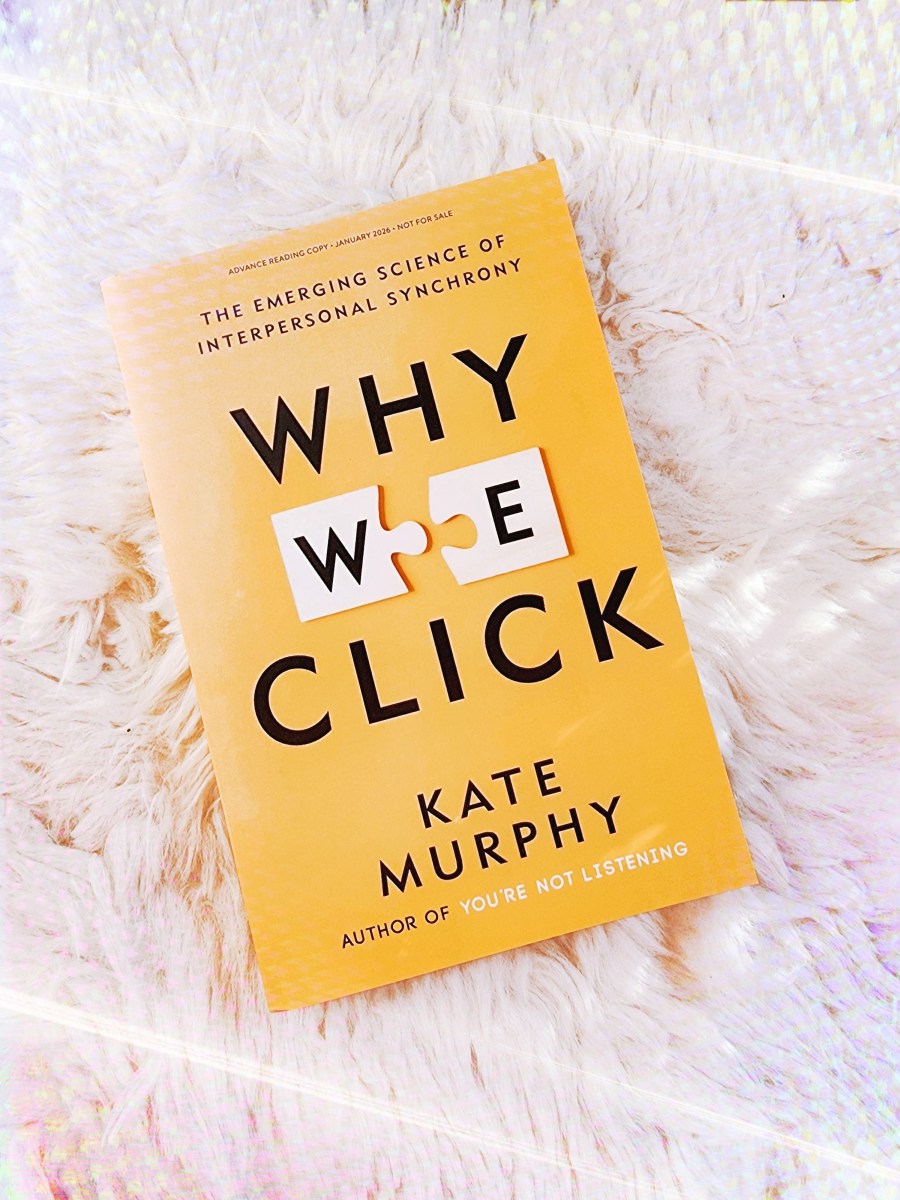
We all know someone who can read a room, and someone who can’t read others at all. We’ve made friends instantly with someone, or admired someone’s social ease, or have read someone’s body language from across the room. What is going on when we meet people, when we feel comfortable building a relationship or repulsed by a toxic behaviour? How is it that some friends can have a whole conversation just via eye contact? This book sets out to explore why we click and what’s really going on in how we relate to each other. It’s all about interpersonal synchrony.
Kate Murphy is the author of You’re Not Listening, which has been made required reading in some universities and colleges across the globe. She’s a journalist known for her accessible, readable style and has written for New York Times, Wall Street Journal and The Economist, amongst other publications.
The chapters in this book are highly detailed and researched and cover different areas of interpersonal relationships and how we sync, like: immediately syncing and attraction, synchronous activities, social contagion, interoception, energy vampires, inter-species relations like pets, mirror neurons, and why we connect with characters and creators.
I loved this book and have already made two of my friends read it. I find the way we think and how our brains work so fascinating, so this was a huge page turner for me. The book explores how we are all “tuning forks” which allows us to do more together than we can alone. We’re wired to survive in community, and can only survive that way, as much as we might like to think otherwise. Our bodies and minds are so wired for this that it can impact our health or even be hacked or tricked by bad actions. In environments like authoritarian families or cultures and spaces like cults, our brains need to sync and mirror are hijacked so that we sync in toxic ways in order to survive. (So calling yourself an alpha human is basically antithetical to the way we survive and thrive, just saying). It can be uncomfortable to realise how influenced and permeable we are, how swayed by fashion and ideas, and also while we might not like to admit it about ourselves, AI and apps, political movements and marketing industries are all hiring neuro-scientists for their own benefit, to greater hack the human need to sync, to mirror and belong.
The more we understand ourselves and each other, the more we can protect ourselves, make better decisions, but also be gentler and more understanding with each other, because after all, we’re all human.
Quite a few things in this book were interesting to me because it talked about things I’ve noticed in relating or relationships, but didn’t know the why, the science behind what was happening. How you can tell immediately if you like someone or not, to the point that people will have a list of what they’re looking for in a partner but then choose someone who doesn’t meet their criteria in person. The way that fictional people, characters in plays and books, can change our lives and how incredibly good reading is for you. Or how dangerous one bad apple can be, as negativity and belligerence hugely impact group settings.
This is a truly fabulous book, so interesting, and also sometimes slightly terrifying. It confronts what it means to be human, how much choice we really have, how controllable we are. In some ways, we are not what we think we are. We are so malleable. And yet, by truly knowing ourselves and how we work, we can understand ourselves, make better choices and have better boundaries. And of course, have better relationships with each other.
Read It If: I guess the subject matter may not appeal to everyone, but if you find relationships or psychology interesting this one is for you. I do think everyone could benefit from knowing more about this subject.
Thank you to Celadon for the ARC of this book for review.
 CravenWild