
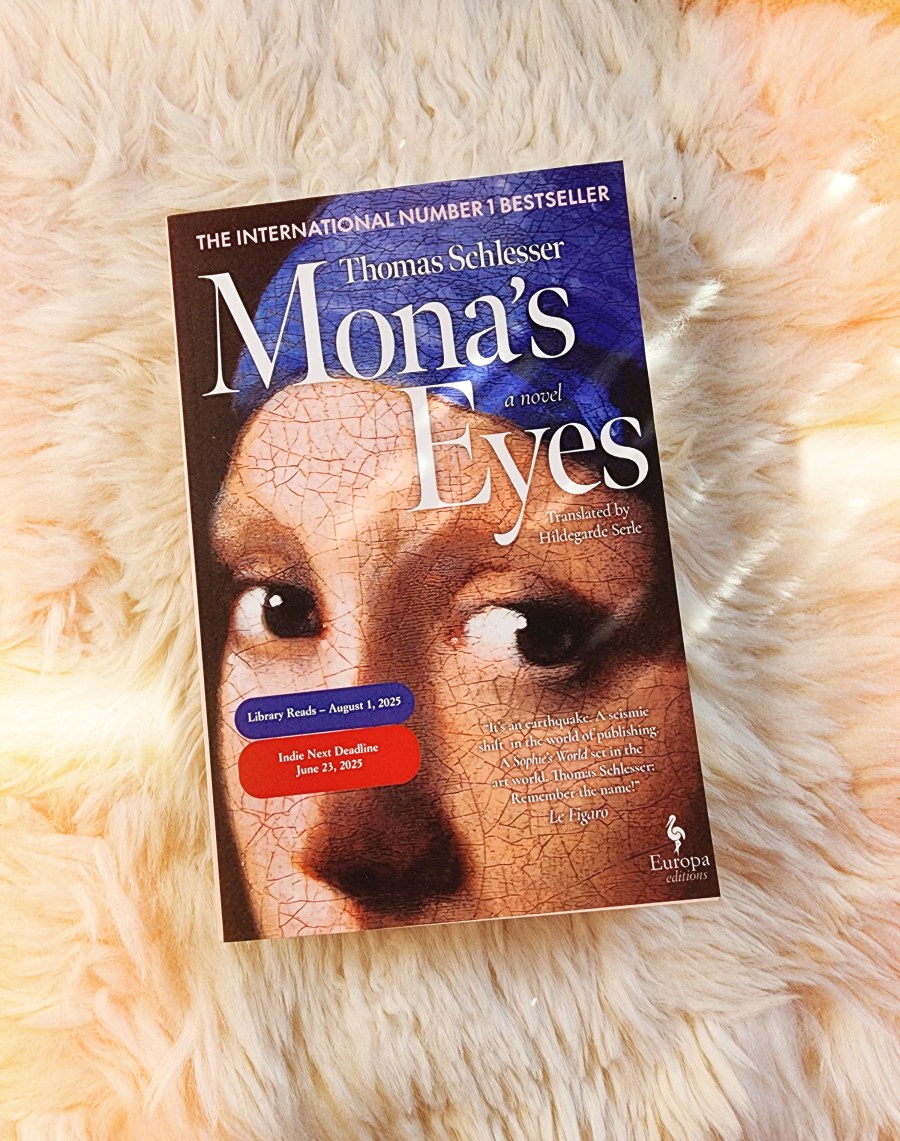
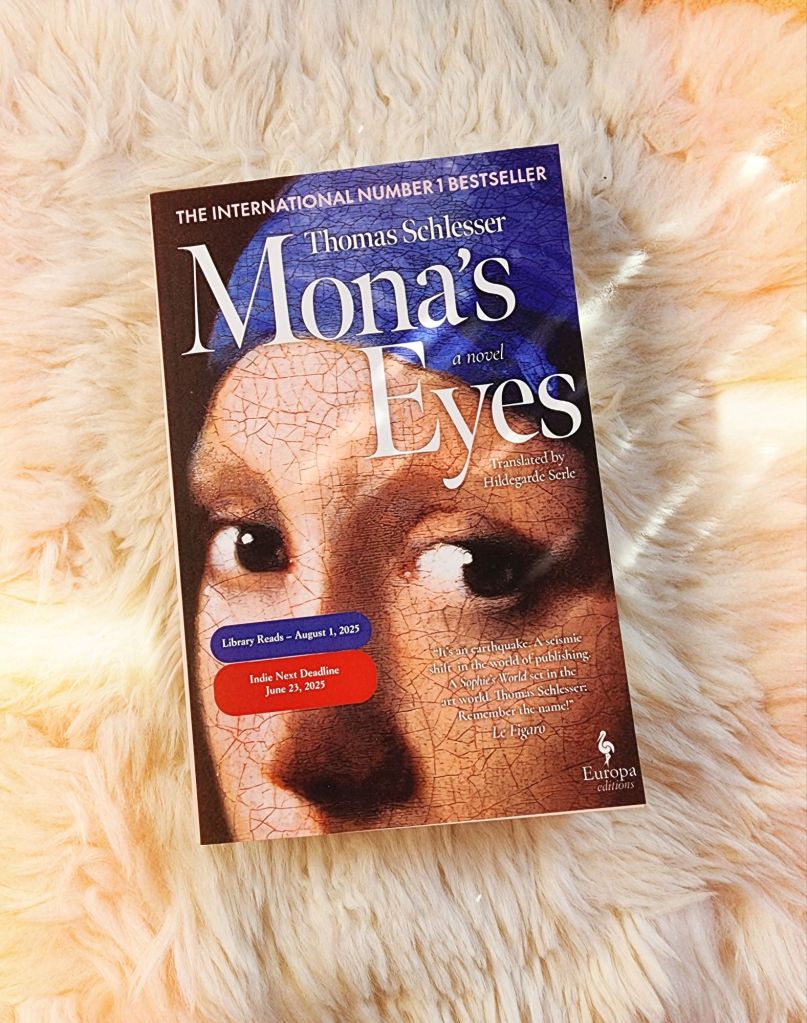
Translated from French by Hildegard Serle.
Mona is ten when she first goes blind for one hour. As doctors try to find out the cause of her malady, her beloved grandfather is tasked with taking her to therapy appointments. Instead, fearing that she may lose her sight, he takes her to see one famous artwork a week, teaching her a little about beauty, life, humanity and of course, art history with each masterwork. What follows is a year in Mona’s life, 52 weeks of life changing art and life lessons, and a journey through five centuries of art history.
Mona’s Eyes is the 2nd novel by the author, his first in English, and he’s also written a lot of non-fiction about art, artists and the relationship between art and politics. Schlesser teaches Art History at the Ecole Polytechnic in Paris and is the director of the Hartung-Bergman Foundation.
The book contains 52 chapters, one for each artwork, and is broken into sections which are labelled with the name of the gallery that houses them in France, starting with the Louvre. Each chapter opens with what’s going on in Mona’s life and her responses to that, and then we get a description of the painting, which helps us notice the details of what we’re looking at, and then her grandfather’s history and life lesson. I think this structure works well, though it can feel a little encyclopedic at times. The description of the paintings was good in some ways, but often the title of the painting described was not clearly included. I was googling each picture as I went, which slowed down my reading flow a bit, which is fine, but having the paintings included or even posting a slide show online somewhere would be great. It’s perhaps a failing in a book about such a visual medium to not include the visuals, though they’re not that hard to find.
This book has been compared to Sophie’s World, in the sense that it’s an older voice teaching a young girl about a subject through a series of lessons. In Jostein Gardners book, a history of philosophy, and in this one, art history. I think that’s a pretty apt comparison. Like that book, it’s fictionalised non-fiction, and we get a lot of information. The relationship between the grandfather Henry and Mona looms large in this book, as he teaches her about life and art, and I quite liked these interactions, though they did not seem deeply based in realism. Henry speaks to her like an adult and sees something in her that is wise beyond her years, which partly explains it, but really, Mona is not a realistic ten year old. But by being a child, it helps the reader relax and see the works through her fresh, childlike gaze, which I think works well. Over the course of the book, the back story of Mona’s year, her parents problems, her school life and friends, really takes a backseat, and is not as compelling as their time in the galleries.
I do think it’s pretty cheeky of the grandfather not to take Mona to her therapy sessions and not tell her parents this. While in the context of the book, it’s a nice secret between them and of benefit to her, it’s perhaps questionable behaviour really. But sometimes books and stories take these kinds of liberties, it’s not a major problem. Her father’s drinking problem is also dealt with fairly lightly, but then, it’s not really the main point of the book.
This book is a calm, measured read. It’s often slow, not a fast paced one at all. It feels like something to spend time with and meander through, much like you would at a gallery. It’s not a novel you can sit down and read end to end. I read mine a few chapters at a time at bedtime, which I really enjoyed. Quite nice to drift off to sleep after reading a few chapters and thinking about the artworks and interpreting meanings behind them. The way the grandfather shares the works is conversational and thought provoking, not preachy or like a dry lecture at all. The life lessons imparted here change Mona, and so these parts feel more real than her real world life at times, and I didn’t mind that. Art can impact us like that sometimes.
I think for some, this book might feel a bit long and not have enough movement and action to the narrative. It’s one to spend time with. Maybe some would prefer reading an encyclopedia OR a novel, rather than this kind of thing, but I liked it. It was quite relaxing, and I loved how with each chapter, the styles and movements of the art works changed. I was OK with Mona and her families and friends lives being like backstory, where you could see some impact, but the time in the galleries being the real meat of the book.
Read It If: you love art and art history, or if you love books like Sophie’s World. It’s more of a meandering, calm book that a strong narrative, but it’s very rewarding reading.
Thanks to PGC Books for the ARC of this book for review.


Pingback: Tata by Valerie Perrin – CravenWild